ECU
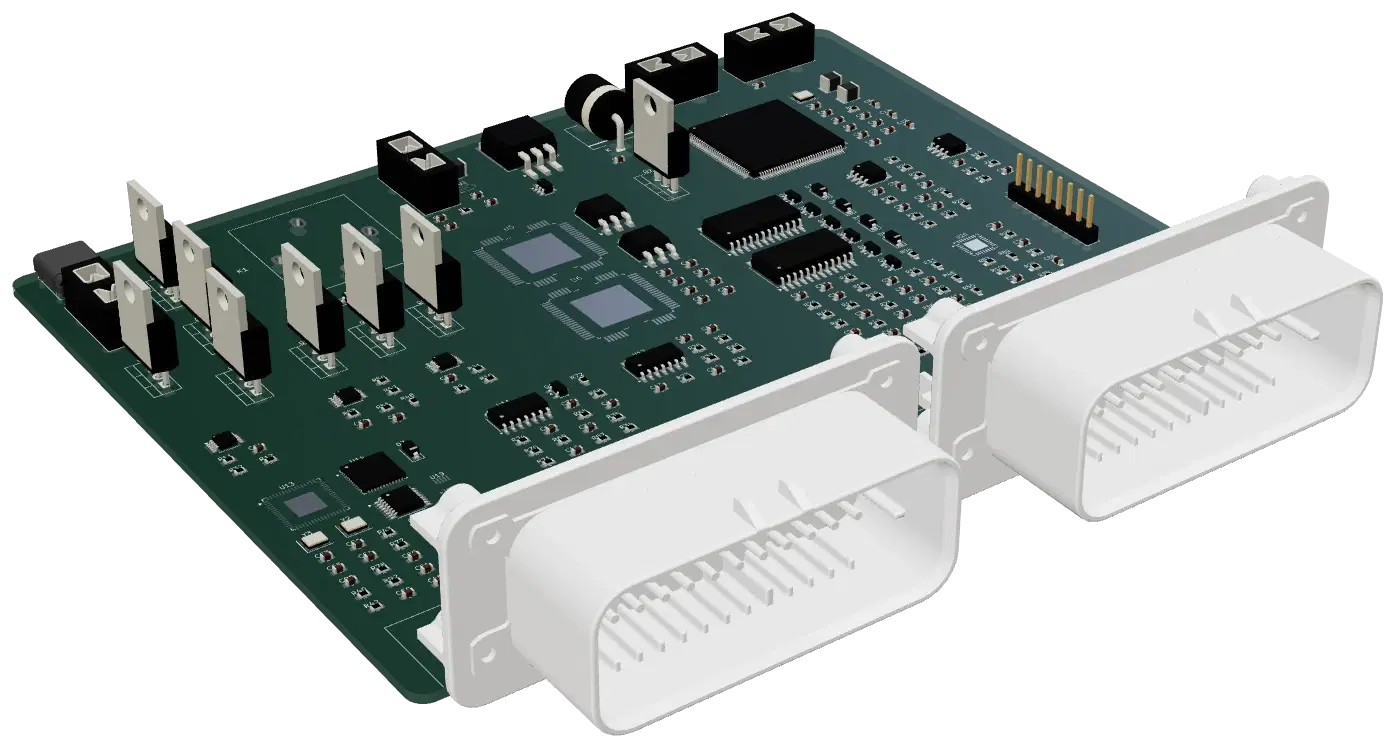
A from-scratch standalone engine management ECU — drives fuel injectors and ignition coils directly, runs closed-loop on engine sensors, and covers 4-, 6-, and 8-cylinder engines from a single board, with drive-by-wire electronic throttle, boost control, EGT, and flex-fuel sensing built in.
Where it stands
In development — design complete, not yet built. The schematic and PCB are finished, fully routed, and pass electrical- and design-rule checks, but no board has been fabricated, assembled, powered, or run on an engine, and the bill of materials is not yet costed.
The firmware has only ever run in host simulation, never on the target chip. Nothing here is a tested or purchasable product.
Specification
- Board size
- 165.8 × 130.2 mm, 8-layer
- MCU
- NXP MPC5606B (144-LQFP, Power Architecture)
- Cylinders supported
- 4 / 6 / 8
- Injector channels
- 8, sequential
- Ignition channels
- 8, per-cylinder
- Electronic throttle
- Drive-by-wire, redundant pedal + throttle sensing
- Boost, EGT, flex-fuel
- 1 channel each
- CAN buses
- 2, independent
- Wideband O2
- 2 channels
- Harness connectors
- 2 × TE AMPSEAL 776180-1, 35-way
- Programming
- USB-C and Bluetooth LE, both full reflash paths
Firmware
A companion firmware project is being built alongside the board. It is not a working ECU, and it is deliberately split into what has been checked against the real documentation and what is still open. The pin map is transcribed from the same generator that produced the board, and the low-level drivers — pin muxing, clock and mode bring-up, the eMIOS timer channels that fire injectors and coils, SPI, ADC, CAN and the interrupt controller — are written against the actual MPC5606B reference manual, not from memory.
On top of that sit fuelling from a volume-efficiency table, spark advance, and injector dead time and coil dwell that follow battery voltage, plus redundancy checks that compare the dissimilar pedal and throttle sensor pairs and can genuinely fail. Engine-specific facts — cylinder count, trigger wheel, firing order — live in one config file that a generator validates.
With no board to run it on, the portable modules are compiled natively and driven by a hardware stub in a set of host tests, which include a sweep of 162 speed and load cases checking every cylinder is armed once per cycle. That loop has already caught real bugs that review and the compiler both missed.
Reference docs
Full technical specification — engine control, sensor inputs, actuator outputs, connector pinouts, and known limitations.
Source
The schematic and board are generated from scripts rather than drawn by hand, so the generators are the source of truth. The design files and notes are in the repository; the firmware lives alongside the board in the same repo.