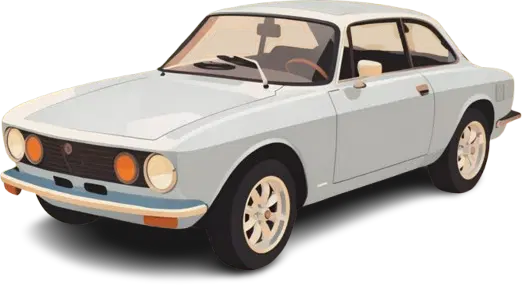
Alfa GTV Cluster
A digital instrument cluster for the 1972 Alfa Romeo GTV 2000, around the same brain board as the Mustang's. The plan is a 4-inch round screen filling each big hood and a 1.5-inch round screen filling each small one, in a housing the size of the stock one, with the brain board in a box of its own.
Where it stands
A first look, nothing more: no board for this car exists. The housing is now sized from photos of a tape measure on the real cluster, which is what brought the screens down to these sizes. That cluster is coming apart next, and its numbers will replace the ones worked out from the photos.
In 3D
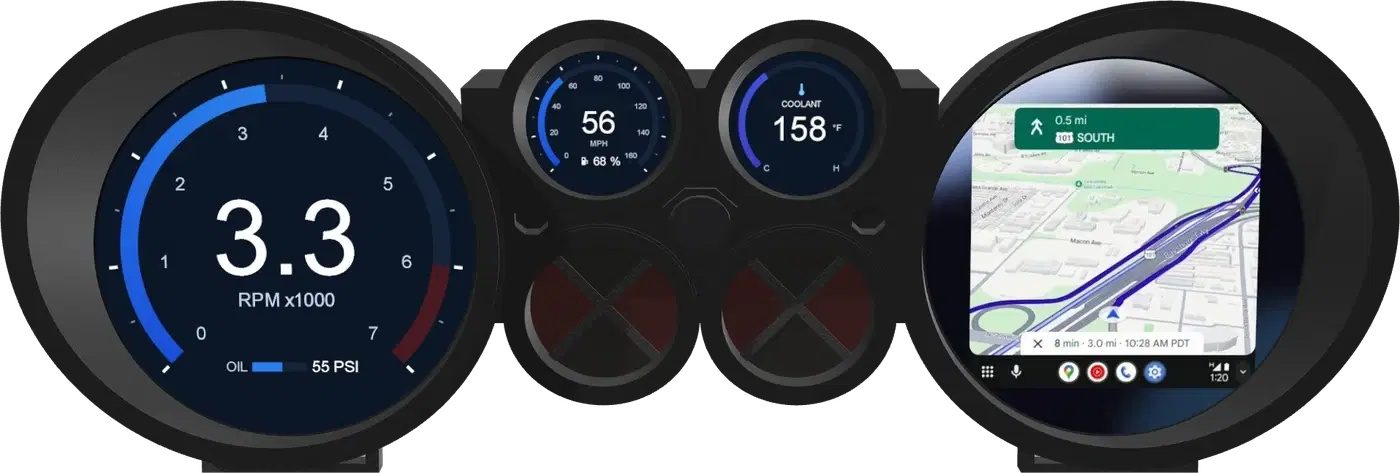
The same idea in a very different dash. The GTV has two big dials in deep hoods, with two small ones between them. Both big screens are the panel from the Mustang's centre, run from the brain board. The small ones would run from the microcontroller, so they keep going if Linux doesn't.
The brain board goes in a box of its own, mounted behind the dash and joined by two ribbon cables. So nothing stands behind the housing, and a second USB-C port leaves room for other mods later.
The warning lamps would stay real LEDs in the stock windows, and the car's two dash plugs would go straight into the new board.
The brain board and the speedometer's panel board are the real ones from their files; the other boards are plain stand-ins. The heatsink is drawn from Toradex's datasheet, and slots in the box's floor and top let air rise through its fins. Where the box sits is only an example.
Android Auto in a big dial
The map takes the speedometer's screen, laid out inside the largest square that fits the circle, and the speed moves to a small screen. The tach stays where it is.
Four looks
The looks carry over from the Mustang, redrawn for two big dials and two small ones. Factory is the stock Jaeger faces of a US car, in English, miles per hour and Fahrenheit. In every look the oil pressure stays on the tach, where the stock car has it. Tap a picture to enlarge it.
Classic
Modern
CarPlay-inspired
Factory
Pictures of the idea, rendered from the 3D model above, with the brain board's box left out. These dials are drawn for the model, not by the cluster's software, which doesn't run on this layout yet, and the map is a frame from the Mustang's demo.
Still open
- The mouths of the hoods and the overall width come off a tape measure, to a few millimetres. The dial positions and hood depths are worked out from photos, and the dash opening and the room behind it haven't been measured, so whether it all fits isn't known yet.
- Where the box can go. One screen's ribbon is DSI, a short-reach link kept to about 150 mm, so for now the box has to sit close to that screen. Longer ribbons get tested first; failing that, more bridge chips would let it go further.
- The brain has one MIPI DSI port, and the 4-inch round screen is DSI, so the second big screen needs a bridge chip on its panel board. That's the biggest unknown: it comes in packs of 2,600, and its set-up for this direction isn't public.
- The screens aren't built for cars: they're rated to +70 °C running. In a cabin that looks livable, by estimate only. A temperature logger in the real hood settles it.
- The 1.5-inch screen is picked from a seller's summary, and nobody has shown the microcontroller can drive it. The board behind it has far less room than the Mustang's: about 9,600 mm² against 29,500 mm², so it may need parts on both sides or a second board.